
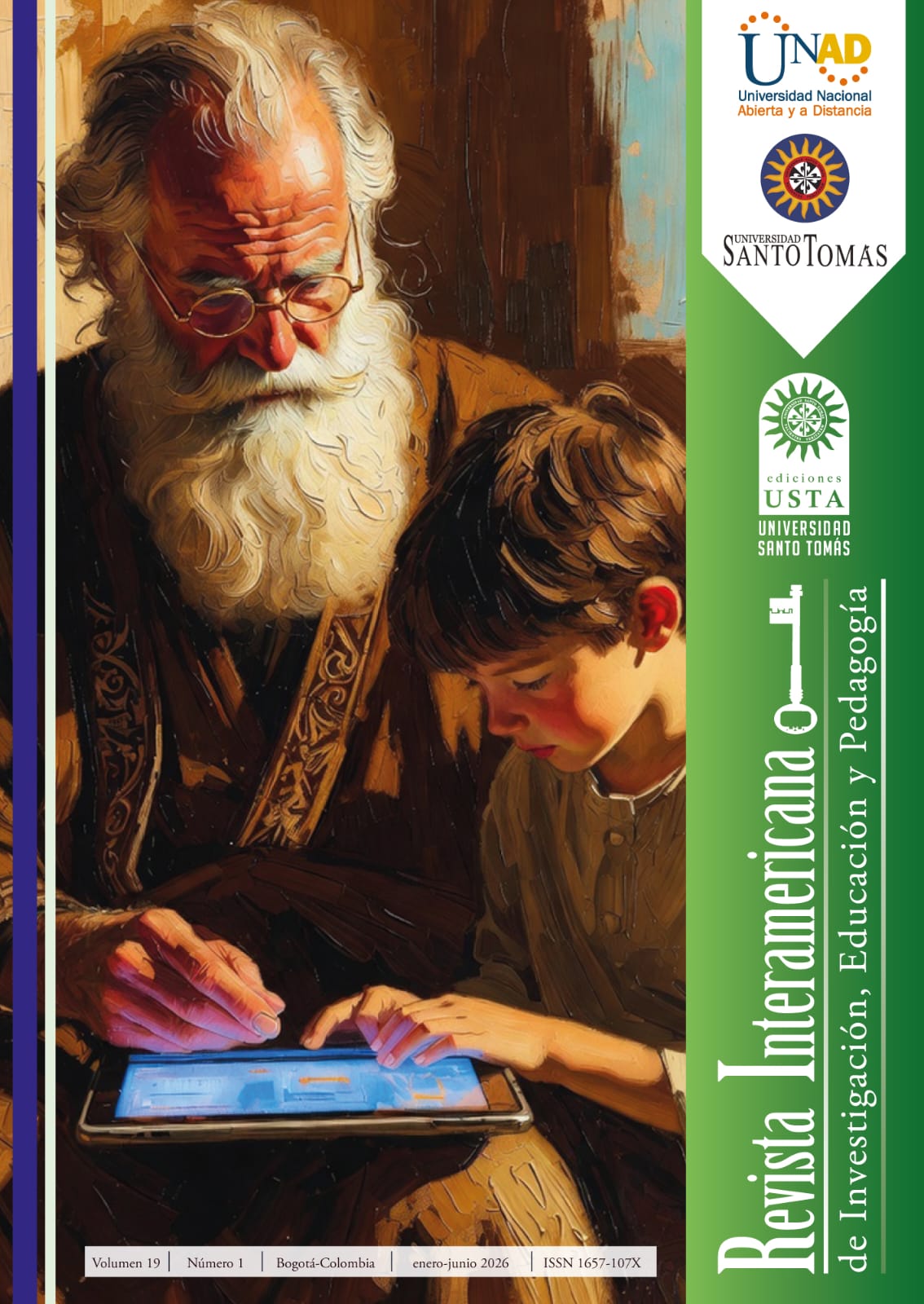
Estado del Arte sobre Inteligencia Artificial y Pensamiento Matemático: Una Revisión Sistemática
State of the Art on Artificial Intelligence andMathematical Thinking: A Systematic Review
Estado da Arte sobre Inteligência Artificial ePensamento Matemático: Uma Revisão Sistemática
Resumen (es)
Objetivo: Examinar la influencia de la inteligencia artificial (IA) en el desarrollo del pensamiento matemático en contextos educativos. Método: Revisión sistemática de la literatura publicada entre 2019 y 2024, mediante búsqueda en bases de datos académicas. Se identificaron 138 artículos y se seleccionaron 45 que cumplieron los criterios de inclusión. Resultados: Se identificaron tres tendencias clave: (1) uso de sistemas tutores inteligentes para personalizar el aprendizaje, (2) aplicación de analíticas de aprendizaje basadas en IA para evaluar el pensamiento matemático, y (3) creación de entornos adaptativos que promueven el razonamiento matemático.Conclusión: Las tecnologías de IA están transformando la enseñanza de las matemáticas, ofreciendo oportunidades para la personalización y evaluación más precisas, y abriendo líneas de investigación pedagógica futuras.
Resumen (pt)
Objetivo. Examinar a influência da inteligência artificial (IA) no
desenvolvimento do pensamento matemático em contextos
educacionais. Método. Revisão sistemática da literatura publicada
entre 2019 e 2024, com busca em bases de dados acadêmicas. Foram
identificados 138 artigos, dos quais 45 atenderam aos critérios de
inclusão. Resultados. Três tendências principais foram identificadas: (1)
uso de sistemas tutores inteligentes para personalizar o aprendizado,
(2) aplicação de análises de aprendizagem baseadas em IA para avaliar o
pensamento matemático, e (3) criação de ambientes de aprendizagem
adaptativos que promovem o raciocínio matemático. Conclusão.
As tecnologias de IA estão transformando o ensino da matemática,
possibilitando personalização e avaliações mais precisas, além de abrir
novas linhas para pesquisas pedagógicas futuras.
Resumen (en)
Objective: To examine the influence of Artificial Intelligence (AI) on the development of mathematical thinking in educational settings. Method: Systematic review of literature published between 2019 and 2024 through searches in academic databases. A total of 138 articles were identified, and 45 met the inclusion criteria. Results: Three main trends emerged: (1) the use of intelligent tutoring systems to personalize learning, (2) AI-based learning analytics to assess mathematical thinking, and (3) adaptive learning environments that foster mathematical reasoning. Conclusion: AI technologies are transforming mathematics education, providing opportunities for personalized and precise assessment, and opening new directions for future pedagogical research.
Referencias
Acendra Pertuz, J. M., & Conde Carmona, R. J. (2024). STEAM para el desarrollo del pensamiento matemático: una revisión documental. Praxis, 20(2). https://doi.org/10.21676/23897856.5783
Alenezi, H., & Faisal, M. (2020). Utilizing crowdsourcing and machine learning in education: Literature review. Education and Information Technologies, 25, 2971-2986. https://doi.org/10.1007/s10639-020-10102-w
Bolaño - García, M., & Duarte - Acosta, N. (2023). Una revisión sistemática del uso de la inteligencia artificial en la educación. Rev Colomb Cir, 39 (1), 51 – 63. https://doi.org/10.30944/20117582.2365
Bozkurt, A., Karadeniz, A., Baneres, D., Guerrero-Roldán, A.E., & Rodríguez, M.E. (2021). Artificial intelligence and reflections from educational landscape: A review of AI studies in half a century. Sustainability, 12(2), 1-16. https://doi.org/10.3390/su13020800
Changoluisa, L. (2024). Efectos de la inteligencia artificial en el desarrollo socioemocional de adolescentes. Ciencia latina científica multidisciplinar, 8(3). https://doi.org/10.37811/cl_rcm.v8i3.11565
Chen, L., Chen, P., & Lin, Z. (2020). Artificial Intelligence in education: A review. IEEE Access, 8, 75264-75278. https://doi.org/10.1109/ACCESS.2020.2988510
Conde-Carmona, R. J., & Padilla-Escorcia, I. A. (2025). El rol de la inteligencia artificial en la educación: el caso de los profesores de matemáticas en formación, expectativas, prácticas y desafíos. Voces Y Silencios. Revista Latinoamericana De Educación, 16(2), 1-26. https://doi.org/10.18175/VyS16.2.2025.1
Crescenzi-Lanna, L. (2023). Literature review of the reciprocal value of artificial and human intelligence in early childhood education. Journal of Research in Technology Education, 55, 21-33. https://doi.org/10.1080/15391523.2022.2128480
Erümit, A.K., & Çetin, I. (2020). Design framework of adaptive intelligent tutoring systems. Education and Information Technologies, 25, 4477-4500. https://doi.org/10.1007/s10639-020-10182-8
Huang, X., & Qiao, C. (2022). Enhancing computational thinking skills through artificial intelligence education at a STEAM high school. Science & Education, 33, 383-403. https://doi.org/10.1007/s11191-022-00392-6
Hwang, G.-J., & Tu, Y.-F. (2021). Roles and research trends of artificial intelligence in mathematics education: A bibliometric mapping analysis and systematic review. Mathematics, 9(6), 1-19. https://doi.org/10.3390/math9060584
İpek, Z.H., Gözüm, A.İ.C., Papadakis, S., & Kallogiannakis, M. (2023). Educational applications of the ChatGPT AI system: Systematic review research. Educational Process: International Journal, 12, 26-55. https://doi.org/10.22521/edupij.2023.123.2
Kajiwara, Y., Matsuoka, A., & Shinbo, F. (2023). Machine learning role playing game: Instructional design of AI education. Computers & Education: Artificial Intelligence, 5, 100162. https://doi.org/10.1016/j.caeai.2023.100162
Kong, S.-C., Cheung, W.M.-Y., & Tsang, O. (2023). Evaluating an artificial intelligence literacy programme for empowering and developing concepts, literacy and ethical awareness in senior secondary students. Education and Information Technologies, 28, 4703-4724. https://doi.org/10.1007/s10639-022-11408-7
Korkmaz, Ö., Çakır, R., & Özden, M.Y. (2017). A validity and reliability study of the computational thinking scales (CTS). Computers in Human Behaviors, 72, 558-569. https://doi.org/10.1016/j.chb.2017.01.005
Lagrange, JB., Richard, P.R., Vélez, M.P., & Van Vaerenbergh, S. (2024). Artificial Intelligence Techniques in Software Design for Mathematics Education. In: Pepin, B., Gueudet, G., Choppin, J. (eds) Handbook of Digital Resources in Mathematics Education. Springer International Handbooks of Education. Springer, Cham. https://doi.org/10.1007/978-3-031-45667-1_37
Lai, T., Xie, C., Ruan, M., Wang, Z., Lu, H., & Fu, S. (2023). Influence of artificial intelligence in education on adolescents' social adaptability: The mediatory role of social support. PLOS ONE, 18(5), e0283170. https://doi.org/10.1371/journal.pone.0283170
Lee, M.R., Yen, A.Y.-J., & Chang, L. (2019). Neurofeedback and AI for analyzing child temperament and attention levels. Knowledge Management and Acquisition for Intelligent Systems, 11669, 21-31. https://doi.org/10.1007/978-3-030-30639-7_3
Lin, X.-F., Wang, Z., Zhou, W., Luo, G., & Hwang, G.-J. (2023). Technological support to foster students' artificial intelligence ethics: An augmented reality-based contextualized dilemma discussion approach. Computers & Education, 201, 104813. https://doi.org/10.1016/j.compedu.2023.104813
Méndez-Parra, C., & Conde-Carmona, R. J. (2025, enero-abril). Integración de STEAM y la realidad aumentada en la enseñanza de la traslación de figuras geométricas. Revista Virtual Universidad Católica del Norte, (74), 69-92. https://www.doi.org/10.35575/rvucn.n74a4
Ministerio de Educación Nacional [MEN] & Instituto Colombiano para la Evaluación de la Educación [Icfes]. (2022). Evaluar para Avanzar 3. ° A 11. °: nota técnica
Mohamed, M. Z. B., Hidayat, R., Suhaizi, N. N. B., Sabri, N. B. M., Mahmud, M. K. H. B., & Baharuddin, S. N. B. (2022). Artificial intelligence in mathematics education: A systematic literature review. International Electronic Journal of Mathematics Education, 17(3), em0694. https://doi.org/10.29333/iejme/12132
Opesemowo, O. A. G. & Ndlovu, M. (2024). Artificial intelligence in mathematics education: The good, the bad, and the ugly. Journal of Pedagogical Research, 8(3), 333-346. https://doi.org/10.33902/JPR.202426428
Padilla-Escorcia, I. A., Conde-Carmona, R. J., Valbuena-Duarte, S., & Berrio-Valbuena, J. D. (2025). Conocimiento del contenido pedagógico tecnológico (TPACK) de profesores de matemáticas en formación inicial de Barranquilla, Colombia. Revista de Investigación, Desarrollo e Innovación, 15 (2), 233-250.
Panglipur, I.R., Palayukan, H., & Dewanti, L. (2024). Artificial Intelligence (AI) Modeling Technique to Improve Creative Thinking on Number Concepts for Early Childhood with Disabilities. Didaktika: Jurnal Kependidikan, 13(1), 461-466.
Panqueban, D., & Huincahue, J. (2024). Artificial intelligence in mathematics education: A systematic review. Uniciencia, 38(1), 1-17. https://doi.org/10.15359/ru.38-1.20
Park, W., & Kwon, H. (2024). Implementing artificial intelligence education for middle school technology education in Republic of Korea. Int J Technol Des Educ 34, 109–135 https://doi.org/10.1007/s10798-023-09812-2
Roll, I., & Wylie, R. (2016). Evolution and revolution in artificial intelligence in education. International Journal of Artificial Intelligence in Education, 26(2), 582-599. https://doi.org/10.1007/s40593-016-0110-3
Sanusi, I.T., Sunday, K., Oyelere, S.S., & Suhonen, J. (2023). Learning machine learning with young children: Exploring informal settings in an African context. Computer Science Education, 34, 161-192. https://doi.org/10.1080/08993408.2023.2175559
Semenov, A.L., Abylkassymova, A.E. & Polikarpov, S.A. Foundations of Mathematical Education in the Digital Age. Dokl. Math. 107 (Suppl 1), S1–S9 (2023). https://doi.org/10.1134/S1064562423700564
Shamir, G., & Levin, I. (2021). Neural network construction practices in elementary school. Künstliche Intelligenz, 35, 181-189. https://doi.org/10.1007/s13218-021-00729-3
Shin, D. (2022). Teaching mathematics integrating intelligent tutoring systems: Investigating prospective teachers' concerns and TPACK. International Journal of Science and Mathematics Education, 20, 1659-1676. https://doi.org/10.1007/s10763-021-10221-x
Shin, J., Chen, F., & Bulut, O. (2021). Analyzing students' performance in computerized formative assessments using deep learning frameworks. Journal of Computer Education, 9, 71-91. https://doi.org/10.1007/s40692-021-00196-7
Su, J., & Yang, W. (2022). Artificial intelligence in early childhood education: A scoping review. Computers & Education: Artificial Intelligence, 3, 100049. https://doi.org/10.1016/j.caeai.2022.100049
Su, J., Ng, D.T.K., & Chu, S.K.W. (2023). Artificial intelligence literacy in early childhood education: The challenges and opportunities. Computers & Education: Artificial Intelligence, 4, 100124. https://doi.org/10.1016/j.caeai.2023.100124
Tamborg, A.L., Elicer, R., Bråting, K., Geraniou, E., Jankvist, U.T., & Misfeldt, M. (2023). The Politics of Computational Thinking and Programming in Mathematics Education: Comparing Curricula and Resources in England, Sweden, and Denmark. In: Pepin, B., Gueudet, G., Choppin, J. (eds) Handbook of Digital Resources in Mathematics Education. Springer International Handbooks of Education. Springer, Cham. https://doi.org/10.1007/978-3-030-95060-6_55-1
Valbuena Duarte, S., Márquez Herrera, L., Conde Carmona, R., y Chiquillo Varela, M. F. (2024). Enfoque STEAM y modelo TPACK en los métodos numéricos aplicados con software. Tecnura, 28(82), 27–47. https://doi.org/10.14483/22487638.22481
Vicente, F.R., Llinares, A.Z., & Sánchez, N.M. (2020). Curriculum analysis and design implementation of a STEAM project through educational robotics in primary education. Computer Applications in Engineering Education, 29(1), 160-174. https://doi.org/10.1002/cae.22373
Wang, X., Li, L., Tan, S.C., Yang, L., & Lei, J. (2023). Preparing for AI-enhanced education: Conceptualizing and empirically examining teachers' AI readiness. Computers & Human Behavior, 146, 107798. https://doi.org/10.1016/j.chb.2023.107798
Wang, X., Liu, Q., Pang, H., Tan, S.C., Lei, J., Wallace, M.P., & Li, L. (2023). What matters in AI-supported learning: A study of human-AI interactions in language learning using cluster analysis and epistemic network analysis. Computers & Education, 194, 104703. https://doi.org/10.1016/j.compedu.2022.104703
Williams, R., Park, H.W., & Breazeal, C. (2019). A is for artificial intelligence: The impact of artificial intelligence activities on young children's perceptions of robots. CHI Conference on Human Factors in Computing Systems, 1-11. https://doi.org/10.1145/3290605.3300677
Wu, C.-H., Liu, C.-H., & Huang, Y.-M. (2022). The exploration of continuous learning intention in STEAM education through attitude, motivation, and cognitive load. International Journal of STEM Education, 9, 35. https://doi.org/10.1186/s40594-022-00346-y
Wu, S.-Y., & Yang, K.-K. (2022). The effectiveness of teacher support for students' learning of artificial intelligence. Frontiers in Psychology, 13, 868623. https://doi.org/10.3389/fpsyg.2022.868623
Yang, K.B., Nagashima, T., Yao, J., Williams, J.J., Holstein, K., & Aleven, V. (2021). Can crowds customize instructional materials with minimal expert guidance? Exploring teacher-guided crowdsourcing for improving hints in an AI-based tutor. Proceedings of the ACM on Human-Computer Interaction, 5, 1-24. https://doi.org/10.1145/3449193
Yim, I.H.Y., & Su, J. (2024). Artificial intelligence (AI) learning tools in K-12 education: A scoping review. Journal of Computer Education, 1-39. https://doi.org/10.1007/s40692-023-00304-9
Zhai, X., He, P., & Krajcik, J. (2022). Applying machine learning to automatically assess scientific models. Journal of Research in Science, 59(10), 1765-1794. https://doi.org/10.1002/tea.21773
Zhang, K., & Aslan, A.B. (2021). AI technologies for education: Recent research & future directions. Computers and Education: Artificial Intelligence, 2, 100025. https://doi.org/10.1016/j.caeai.2021.100025
Cómo citar
Licencia
Derechos de autor 2025 Revista Interamericana de Investigación Educación y Pedagogía RIIEP

Esta obra está bajo una licencia internacional Creative Commons Atribución-NoComercial-CompartirIgual 4.0.
Los autores mantienen los derechos sobre los artículos y por tanto son libres de compartir, copiar, distribuir, ejecutar y comunicar públicamente la obra bajo las condiciones siguientes:
Reconocer los créditos de la obra de la manera especificada por el autor o el licenciante (pero no de una manera que sugiera que tiene su apoyo o que apoyan el uso que hace de su obra).
RIIEP está bajo una licencia Creative Commons Atribución-NoComercial-CompartirIgual 4.0 Internacional (CC BY-NC-SA 4.0)

La Universidad Santo Tomás conserva los derechos patrimoniales de las obras publicadas, y favorece y permite la reutilización de las mismas bajo la licencia anteriormente mencionada.


