
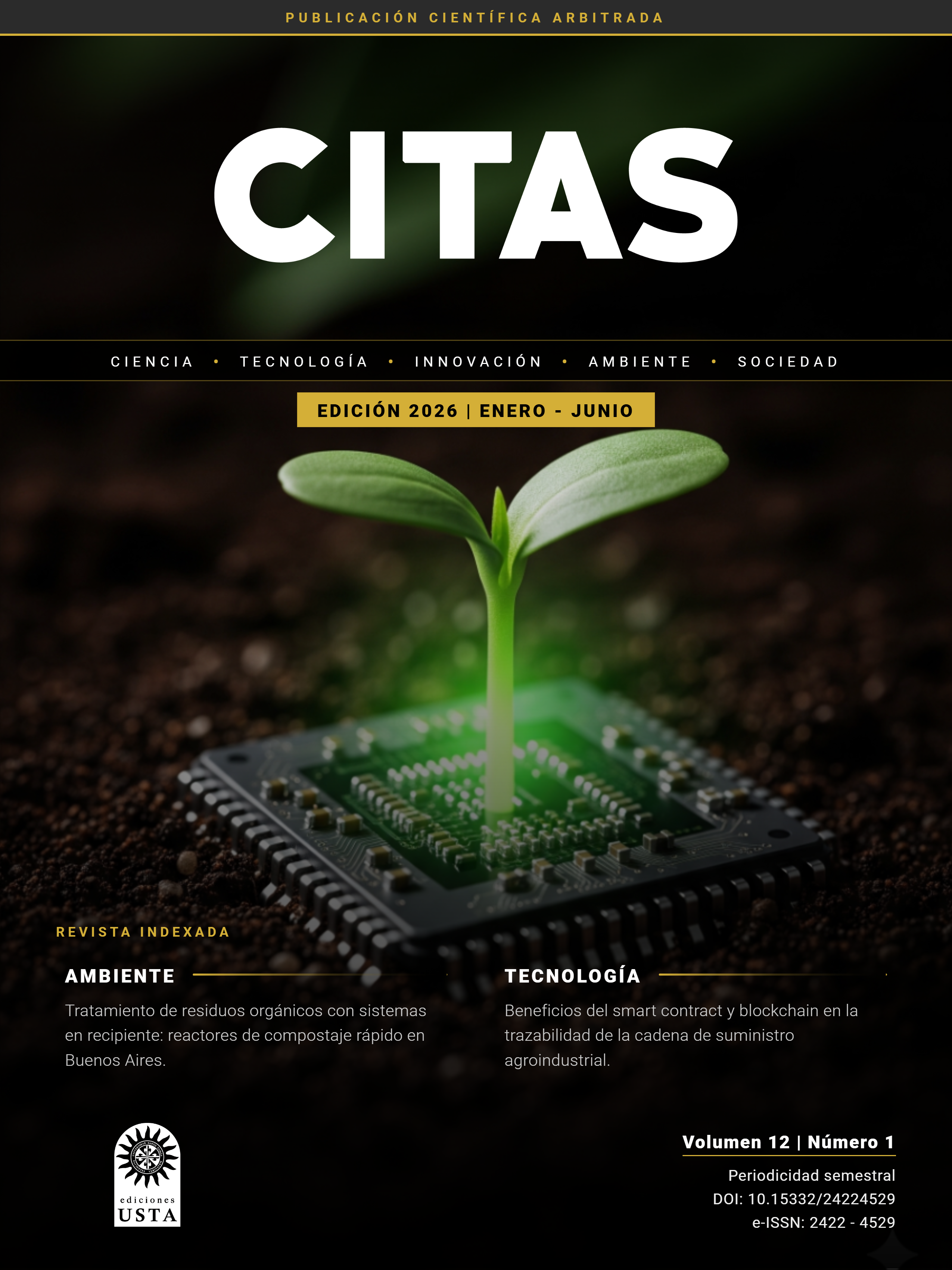
Beneficios del smart contract y blockchain en la trazabilidad de la cadena de suministro agroindustrial del banano
Benefits of smart contract and blockchain in the traceability for the banano agroindustrial supply chain
Abstract (en)
Efficient management of global supply chains requires companies to make quick decisions and monitor them accurately. Tracking logistics activities and processes using technologies such as Blockchain provides decentralized, real-time information sharing among several different companies, eliminating intermediaries. This article presents an analysis of the impact of using Smart Contracts and Blockchain for process traceability in the supply chain. The agribusiness sector can benefit from the development of smart contracts and blockchain to make decisions based on real-time information, making the tracking of these decisions a response to a critical need. The integrity of the information provided by the use of some technologies supports decision-making in globalized markets, with processes dependent on other systems, and under the uncertainty of global management.
Abstract (es)
La gestión eficiente de cadenas de suministro globales exige a las empresas tomar decisiones rápidas y monitorearlas de forma precisa. El seguimiento de actividades y procesos logísticos bajo tecnologías como blockchain permite compartir información en tiempo real y de forma descentralizada entre diferentes empresas, eliminando los intermediarios. El sector agroindustrial puede beneficiarse del desarrollo de smart contracts —contratos inteligentes— y blockchain —cadena de bloques— para tomar decisiones con información en tiempo real y realizar su seguimiento, como respuesta a una necesidad crítica. Este artículo presenta un análisis del impacto de usar tecnologías como smart contract y blockchain para la trazabilidad de los procesos en la cadena de suministro. La integridad en la información que ofrecen tecnologías como las mencionadas apoya la toma de decisiones en mercados globalizados que tienen procesos dependientes de otros sistemas y se encuentran bajo la incertidumbre de la gestión global.
References
Alimahomed-Wilson, J. y Ness, I. (Eds.). (2018). Choke points: Logistics workers disrupting the global supply chain. Pluto Press. https://doi.org/10.2307/j.ctt21kk1v2
Baralla, G., Pinna, A. y Corrias, G. (2019). Ensure traceability in European food supply chain by using a blockchain system. Proceedings of WETSEB, 40-47. https://doi.org/10.1109/WETSEB.2019.00012
Departamento Nacional de Planeación (DNP). (2025). Documento CONPES 3547: Política nacional logística.
Departamento Nacional de Planeación (DNP) y Ministerio de Transporte. (2023). Encuesta Nacional Logística 2022: Principales resultados y análisis. https://onl.dnp.gov.co/oli/Paginas/Logistica/ENL.aspx
Hu, Y., Liyanage, M., Manzoor, A., Thilakarathna, K., Jourjon, G. y Seneviratne, A. (2019). Blockchain-based smart contracts - Applications and challenges. ArXiV. https://doi.org/10.48550/arXiv.1810.04699
Marchesi, L., Marchesi, M. y Tonelli, R. (2020). ABCDE – Agile Block Chain Dapp Engineering. Blockchain Research and Applications, 1(1-2), 100002. https://doi.org/10.1016/j.bcra.2020.100002
Nakamoto, S. (2008). Bitcoin: A peer-to-peer electronic cash system. Bitcoin.org. https://bitcoin.org/bitcoin.pdf
Ocariz, E. B. (2019). Blockchain y Smart Contract. La revolución de la confianza. Alfaomega Colombiana S.A.
Saltini, R. y Akkerman, R. (2012). Testing improvements in the chocolate traceability system: Impact on product recalls and production efficiency. Food Control, 23(1), 221-226. https://doi.org/10.1016/j.foodcont.2011.07.015
Thakur, M. y Hurburgh, C. R. (2009). Framework for implementing traceability system in the bulk grain supply chain. Journal of Food Engineering, 95(4), 617-626. https://doi.org/10.1016/j.jfoodeng.2009.06.028
Tian, F. (2016, junio 25-27). An agri-food supply chain traceability system for China based on Blockchain and RFID technology [ponencia]. 13th International Conference on Service Systems and Service Management (ICSSSM), Kunming, China. https://doi.org/10.1109/ICSSSM.2016.7538424
How to Cite
License
Copyright (c) 2026 CITAS

This work is licensed under a Creative Commons Attribution-NonCommercial-ShareAlike 4.0 International License.
The authors sign a transfer of rights so that Universidad Santo Tomás can publish the articles under the conditions described below. The authors, readers and other users are free to share, copy, distribute, perform and publicly communicate the work under the following conditions:
-
Attribution — You must give appropriate credit, provide a link to the license, and indicate if changes were made. You may do so in any reasonable manner, but not in any way that suggests the licensor endorses you or your use.
-
NonCommercial — You may not use the material for commercial purposes.
-
ShareAlike — If you remix, transform, or build upon the material, you must distribute your contributions under the same license as the original.
No additional restrictions — You may not apply legal terms or technological measures that legally restrict others from doing anything the license permits.
CITAS is licensed under Creative Commons Attribution-NonCommercial-ShareAlike 4.0 International (CC BY-NC-SA 4.0).

Until 2019 the documents published in the magazine were under the Creative Commons Attribution-ShareAlike license (CC BY-SA), however, in order to guarantee the open and free distribution of the content published in the magazine, it was decided to change the type Commons Attribution-NonCommercial-ShareAlike 4.0 International license (CC BY-NC-SA 4.0)


