
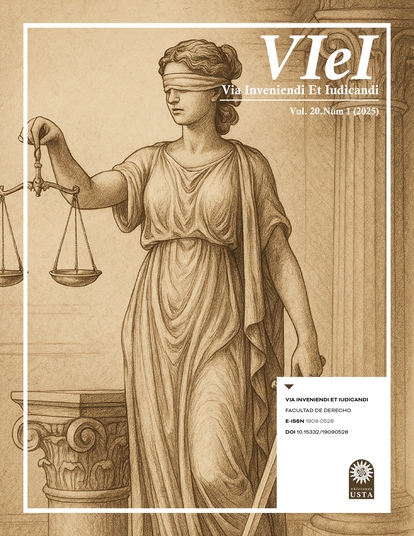
Application of artificial intelligence as a way of digitalizing the system of justice: legal, economic and social issues
Aplicación de la inteligencia artificial como forma de digitalizar el sistema de justicia: cuestiones jurídicas, económicas y sociales
Resumen (es)
El artículo aborda las cuestiones jurídicas, sociales y económicas derivadas de la introducción de la inteligencia artificial en el sistema judicial. Se centra en la protección de los derechos humanos y las libertades fundamentales en el contexto de la aplicación de la inteligencia artificial en los procedimientos judiciales. La metodología del artículo incluye los métodos deductivo, comparativo, histórico, pronóstico, estructural y funcional, así como el análisis de sistemas y la generalización científica. Se examina la amplia experiencia internacional en la aplicación de sistemas de inteligencia artificial en el sistema judicial de numerosos países, como Estados Unidos, China, India, Brasil y el Reino Unido. Se presta especial atención a la legislación de los países que ya han adoptado la inteligencia artificial en sus sistemas judiciales. Además, se presta especial atención a la primera ley integral de legislación internacional dedicada a la inteligencia artificial: la Ley de IA de la Unión Europea. Se ha demostrado que el uso de la inteligencia artificial puede aumentar la eficiencia de los procedimientos judiciales y facilitar el acceso a la justicia para la ciudadanía. Sin embargo, también existen preocupaciones sobre la accesibilidad y equidad tecnológica, la falta de confianza pública, la transparencia y la vulneración de la autoridad judicial, así como los costos financieros que supone la introducción de herramientas de IA en los tribunales. Se concluye que un marco jurídico sólido, junto con la supervisión humana y los estándares éticos en materia de inteligencia artificial, son esenciales para la protección de los derechos humanos fundamentales y el mantenimiento de la confianza pública en el poder judicial.
La frase “la vulneración de la autoridad judicial” podría ser confusa. Se sugiere reformularla para aclarar si se refiere a la erosión de la autoridad judicial debido a la IA o a la posible violación de la autoridad judicial por parte de la IA.
La frase “los costos financieros que supone la introducción de herramientas de IA en los tribunales” podría ser más precisa. Se podría considerar especificar qué tipos de costos se están mencionando (por ejemplo, costos de implementación, mantenimiento, capacitación, etc.).
Resumen (en)
The article addresses legal, social, and economic issues arising from the introduction of artificial intelligence in the judiciary. The primary focus of the article is the protection of fundamental human rights and freedoms in the context of applying artificial intelligence in judicial proceedings. The methodology employed includes deductive, comparative, historical, prognostic, structural, and functional methods, as well as system analysis and scientific generalization. A wide range of international experiences in applying artificial intelligence systems within the judiciaries of various countries, such as the USA, China, India, Brazil, and the UK, is examined. Significant attention is devoted to the legislation of countries that have already integrated artificial intelligence into their justice systems. Moreover, particular emphasis is placed on the first comprehensive act of international legislation dedicated to artificial intelligence—the AI Act of the European Union. It is demonstrated that the use of artificial intelligence can increase the efficiency of judicial proceedings and facilitate access to justice for ordinary people. However, concerns remain regarding technological accessibility and fairness, a lack of public trust, transparency, the potential compromising of judicial authority, and the financial costs associated with introducing AI tools in courts. The conclusion drawn is that a robust legal framework, along with human oversight and ethical standards concerning artificial intelligence, is essential for protecting fundamental human rights and maintaining public confidence in the judiciary.
Referencias
Acosta Rodríguez, J. E., & Gual Acosta, J. M. (2021). La delimitación de la libertad contractual en virtud de exigencias sociales. Revista IUSTA, 55. https://doi.org/10.15332/25005286.6850 DOI: https://doi.org/10.15332/25005286.6850
Brehm, K., Hirabayashi, M., Langevin, C., Munozcano, B., Sekizawa, K., & Zhu, J. (2020). The future of AI in the Brazilian judicial system – AI mapping, integration, and governance. Columbia University SIPA. https://itsrio.org/wp-content/uploads/2020/06/SIPA-Capstone-The-Future-of-AI-in-the-Brazilian-Judicial-System-1.pdf
British Columbia Civil Resolution Tribunal. (2023). Annual report of 2022/2023. https://civilresolutionbc.ca/wp-content/uploads/CRT-Annual-Report-2022-2023.pdf
Brunette, A. (2024). Humanizing justice: The transformational impact of AI in courts, from filing to sentencing. https://www.thomsonreuters.com/en-us/posts/ai-in-courts/humanizing-justice/
CEPEJ. (2018). European ethical charter on the use of artificial intelligence in judicial systems and their environment. Council of Europe. https://rm.coe.int/ethical-charter-en-for-publication-4-december-2018/16808f699c
CEPEJ. (2021). Action plan: “Digitalization for a better justice”. Council of Europe. https://rm.coe.int/cepej-2021-12-en-cepej-action-plan-2022-2025-digitalisation-justice/1680a4cf2c
Chen, B., & Li, Z. (2020). How will technology change the face of Chinese justice? Columbia Journal of Asian Law, 34(1), 1–58. https://doi.org/10.7916/cjal.v34i1.7484
Council of Europe. (1950). European convention on human rights. https://www.echr.coe.int/documents/d/echr/convention_ENG
Coimbra Campos, E. V. (2023). Artificial intelligence, the Brazilian judiciary and some conundrums. SciencesPo. https://www.sciencespo.fr/public/chaire-numerique/en/2023/03/03/article-artificial-intelligence-the-brazilian-judiciary-and-some-conundrums/
Deeks, A. (2019). The judicial demand for explainable artificial intelligence. Columbia Law Review, 119(7), 1829-1850. https://ssrn.com/abstract=3440723
European Commission. (2021). Proposal on a regulation of the European Parliament and the Council laying down harmonized rules on artificial intelligence. https://eur-lex.europa.eu/legal-content/EN/TXT/?uri=celex:52021PC0206
European Parliament. (2021). Artificial intelligence in criminal law and its use by the police and judicial authorities in criminal matters: Resolution of 6 October 2021 (2020/2016(INI)). https://eur-lex.europa.eu/legal-content/EN/TXT/?uri=%20CELEX%3A52021IP0405
European Parliament. (2022). Report on artificial intelligence in the digital age (2020/2266(INI)). https://www.europarl.europa.eu/doceo/document/A-9-2022-0088_EN.html
European Parliament. (2024). Artificial Intelligence Act: Regulation of 13 March 2024 (2021/0106 (COD)). https://artificialintelligenceact.eu/the-act/
Fernández Muñoz, M. L. (2021). La ampliación del concepto tradicional de wrongful conception en el campo de la responsabilidad médica en Colombia. Revista IUSTA, 54. https://doi.org/10.15332/25005286.6550 DOI: https://doi.org/10.15332/25005286.6550
Garrett, B., & Monahan, J. (2019). Assessing risk: The use of risk assessment in sentencing. Judicature, 103(2), 42–49. https://heinonline.org/HOL/LandingPage?handle=hein.journals/judica103&div=29
General Office of the CCP Central Committee & General Office of the State Council. (2022, March 20). Opinions on strengthening the ethical governance of science and technology [Circular]. https://www.gov.cn/zhengce/2022-03/20/content_5680105.htm
Hill, K. (2020, June 24). Wrongfully accused by an algorithm. The New York Times. https://www.nytimes.com/2020/06/24/technology/facial-recognition-arrest.html
Khan, A. (2023). AI-powered Indian judiciary: A step forward or cause for concern? Bar and Bench. https://www.barandbench.com/columns/litigation-columns/ai-powered-indian-judiciary-a-step-forward-cause-concern
Khrypun, V. (2024). Judges will be allowed to use artificial intelligence during the preparation of court decisions. Court Legal Gazette. https://sud.ua/uk/news/publication/310172-sudyam-razreshat-ispolzovat-iskusstvennyy-intellekt-pri-podgotovke-sudebnykh-resheniy
Latorre-Iglesias, E. L., Donzis, R. H., Caamaño Yusti, A. U., & Lindo Montañez, G. P. (2023). Grobalización, precariedad laboral y e-paranoias: La cara oculta de la narrativa globalizante. IUSTA, 59, 97–118. https://doi.org/10.15332/25005375.9652 DOI: https://doi.org/10.15332/25005375.9652
Lotysh, T. (2024). Application of artificial intelligence in motivating court decisions in criminal proceedings: International experience and prospects for Ukraine. ScienceRise: Juridical Science, 1(27), 52–57. https://doi.org/10.15587/2523-4153.2024.301533 DOI: https://doi.org/10.15587/2523-4153.2024.301533
Mehra, S. (2021). AI is set to reform justice delivery in India. INDIAai. https://indiaai.gov.in/article/ai-is-set-to-reform-justice-delivery-in-india
Rasheed, A. (2022). Abu Dhabi criminal cases now followed up by artificial intelligence. Gulf News. https://gulfnews.com/uae/crime/abu-dhabi-criminal-cases-now-followed-up-by-artificial-intelligence-1.89792712
Shevchuk, O. (2024). Problems of legal regulation of artificial intelligence in administrative judicial procedure. Juridical Tribune, 13(3), 346–362. https://www.researchgate.net/publication/385302698_Problems_of_legal_regulation_of_artificial_intelligence_in_administrative_judicial_procedure DOI: https://doi.org/10.24818/TBJ/2023/13/3.02
Teremetskyi, V., & Kovalchuk, O. (2024). Artificial intelligence as a factor in the digital transformation of the justice system. Forum Prava, 78(1), 106–115. https://doi.org/10.5281/zenodo.10870779
The White House Administration. (2023, October 30). Executive order on the safe, secure, and trustworthy development and use of artificial intelligence [Order]. https://www.whitehouse.gov/briefing-room/presidential-actions/2023/10/30/executive-order-on-the-safe-secure-and-trustworthy-development-and-use-of-artificial-intelligence/
USAID. (2024). Concept of the single court information and communication system. https://court.gov.ua/storage/portal/dsa/news/Kontseptsia%20ESIKS.pdf
Sánchez Acevedo, M. E. (2024). Regulación de algoritmos y sistemas de IA para la toma de decisiones judiciales, la toma de decisiones con sistemas de IA en la justicia colombiana. Via Inveniendi Et Iudicandi, 19(1), 73–104. https://doi.org/10.15332/19090528.10098 DOI: https://doi.org/10.15332/19090528.10098
Zabala Leal, T. D., & Gómez Macfarland, C. A. (2024). La responsabilidad civil y la ética en la inteligencia artificial: una revisión sistemática de las ideas del período 2018–2023. IUSTA, 60, 66–93. https://doi.org/10.15332/25005286.9964 DOI: https://doi.org/10.15332/25005286.9964
Cómo citar
Licencia

Esta obra está bajo una licencia internacional Creative Commons Atribución-NoComercial-CompartirIgual 4.0.
Los autores mantienen los derechos sobre los artículos y por tanto son libres de compartir, copiar, distribuir, ejecutar y comunicar públicamente la obra bajo las condiciones siguientes:
Reconocer los créditos de la obra de la manera especificada por el autor o el licenciante (pero no de una manera que sugiera que tiene su apoyo o que apoyan el uso que hace de su obra).
VIeI está bajo una licencia Creative Commons Atribución-NoComercial-CompartirIgual 4.0 Internacional (CC BY-NC-SA 4.0)

La Universidad Santo Tomás conserva los derechos patrimoniales (copyright) de las obras publicadas, y favorece y permite la reutilización de las mismas bajo la licencia anteriormente mencionada.


